


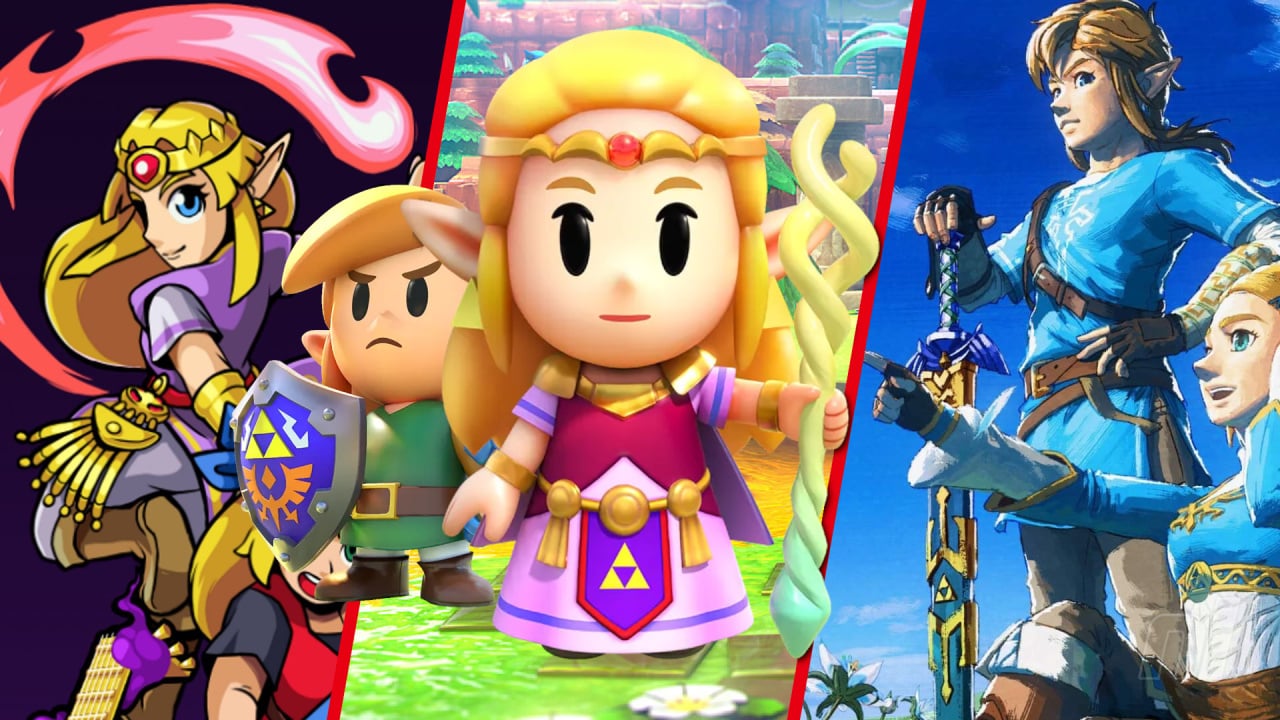
A collaborative adventure in the Legend of Zelda mould was something many had dreamt of for a long time, and the Four Swords part of the GBA port of A Link to the Past made the jump to the TV screen here in Four Swords Adventures.
There’s a single-player game in there, but the real meat of the experience involved four players hooking their own GBA to a GameCube with the requisite link cable and controlling their Link in a screen-hopping adventure long before Nintendo went asymmetric with the Wii U gamepad.
It’s a brilliant co-op Zelda game hampered only by the fact that it required so much kit to function.
The Legend of Zelda: Phantom Hourglass had everything you would expect from a Zelda game and was a worthy stylus-controlled entry on DS.
Starring ‘Toon Link’ from The Wind Waker, Phantom Hourglass made great use of the touchscreen and, combined with the layout, structure, and design typical of the Zelda franchise, made this a familiar yet fresh entry.
If you missed Phantom Hourglass, don’t listen to the naysayers — this is a wonderful little experience that’s still worth hunting down.
A hack-and-slash take on the Zelda universe originally released on the Wii U before receiving a ‘Legends’ 3DS port and arriving on Switch in 2018, Hyrule Warriors: Definitive Edition — like many a Musou — is a great time-sink if you fancy giving the grey matter a rest and whooping the behinds of hundreds of moblins at once.
There are dozens — if not hundreds — of hours of content here, all crammed with affectionate nods to the wider series, with familiar characters and the first (and hopefully not last) appearance of Linkle, a girl who believes she is the reincarnation of the series’ hero.
Though bloated in places, Hyrule Warriors balances the Zelda and Dynasty Warriors elements well. Group all of that with stellar presentation and impressive portable gameplay, and Omega Force and Team Ninja did an excellent job of doing something new (and weird) with a classic Nintendo property.
The Legend of Zelda: Spirit Tracks suffers from a bad reputation, but if you can get past being tied to a track, it really is an excellent game. Trading sailing the high seas for choo-chooing across the kingdom by rail, you plot a route, set the speed, and clear the path of enemies using the train-mounted cannon.
Spirit Tracks gave Zelda a proper role for once and also famously used the DS’s microphone; you could blow into it to use the Whirlwind and Spirit Pipes, among other items. A fun idea in concept, although playing in a noisy environment would interfere with its function.
Tweaking, expanding, and in some ways improving on Phantom Hourglass while throwing in new novelties, with a fabulous soundtrack that stands alongside the best of the series, we think it’s time to reevaluate this entry in the storied franchise. C’mon, ride the train.
Hyrule Warriors: Age of Imprisonment is a stunning slice of action, and perhaps our favourite musou game so far. Lessons have been learned from both Hyrule Warriors and Age of Calamity, resulting in a game that balances big-time story with top-notch combat that’s got proper depth to it.
With Zonai devices to play with, a cracking roster, tons of sexy Sync Strikes to pull off, and a ludicrously slick recreation of early Hyrule to set about kicking ass in, this is dream time for hack-and-slash fans and Zelda enthusiasts alike.
Yes, map layouts are still a bit bland, and co-op mode is 30fps, but everything else here combines to make for the best entry in this spin-off franchise to date.
Hyrule Warriors: Age of Calamity uses the Dynasty Warriors format, but borrows a layer of Breath of the Wild’s polished presentation and story, which elevates it in our eyes.
Boasting a large cast of familiar characters — each with their own movesets and weapons — it gives you the chance to fight the Calamity 100 years before the events of BOTW. Performance could be better in some parts (dramatically better on occasion), but frame rate drops didn’t affect our enjoyment of this Hylian hack-and-slasher.
This would be a good option for people who have exhausted BOTW and TOTK but still want to spend quality time in that world. Teaming up with the Four Champions is a treat, and while Age of Calamity is obviously riding on Breath of the Wild’s coattails, we enjoyed our time with this quasi-prequel adventure.
The Legend of Zelda: Skyward Sword HD introduced a raft of technical improvements and quality-of-life updates that revitalised the Wii game.
The alternate button control scheme totally worked if you still couldn’t get on with the motion controls, the graphics got a sensitively handled HD overhaul, and a once-bothersome sidekick was streamlined into something altogether more useful.
Yes, the locking off of instant travel behind the official amiibo was a misstep, but beyond that issue, this was a great remaster of Zelda game that splits opinion.
What is there left to say about The Legend of Zelda?
The game that started it all holds up well, although be prepared to explore and really work for the answers to puzzles here. A modern game would never ask you to try setting random bushes alight to reveal a hidden passageway without signalling it with a huge neon ‘SECRET HERE!’ sign. The Legend of Zelda trusted the player and had faith in its own strengths enough to let you miss things.
It was a very unique prospect back in 1987, offering an unparalleled sense of adventure, clever combat mechanics, and a world ripe for exploration. Decades later, developers of titles big and small are still borrowing from it.
A landmark game that still feels fresh. Definitely worth revisiting, although if you’ve never played the series, we wouldn’t recommend playing this one first.
Showcasing the sort of swordplay we’d hoped Twilight Princess would contain, The Legend of Zelda: Skyward Sword was a beautiful entry in the series which dared to try some new ideas, something the franchise desperately needed at the time.
It arguably didn’t get everything right, and why Nintendo ditched the beautifully accurate IR pointer in favour of a gyro alternative which required constant re-centering — especially when everyone already had the IR sensor hooked up anyway! — is still a source of confusion for us. We found the MotionPlus swordplay itself excellent, though.
Chronologically, this is the very first game in the Zelda timeline, so it’s pretty much required reading for series fans. While it has its naysayers, we look back on our time with Skyward Sword very fondly.
If you’re looking for a straightforward Zelda adventure, this battle-heavy quest is about as straightforward as it gets. Oracle of Seasons put combat centre stage but adds in enough originality to keep it from feeling monotonous.
Developed by Capcom subsidiary Flagship and helmed by Hidemaro Fujibayashi, director of several later games including Breath of the Wild and Tears of the Kingdom, Seasons was most notable for allowing you to use the Rod of Seasons (shocker!) to shift the world’s climate and solve a variety of puzzles, from freezing lakes to growing Deku Flowers. This smart weather-switching system would later be revisited in various other Zelda entries.
There is much incentive to play these games together, and if you’re wondering which Oracles game to play first, we’d recommend tackling this one second. Doing so adds in interesting plot twists that enhance the relatively barebones storytelling and enables crucial weapon upgrades that help against the challenging end boss.
It may not be as engrossing as Ages, but Seasons still offers up an old-school adventure that will feel fondly familiar to long-time franchise fans.
With the titular princess taking a starring role in her namesake series for the first time, The Legend of Zelda: Echoes of Wisdom should be the new standard for top-down Zelda going forward.
Rather than abandoning the classic formula, Zelda has shown that the old and the new can come together and produce wonderful results that reward experimentation and reinforce the joy of play.
In our book, this is easily in contention with A Link to the Past and A Link Between Worlds as one of the best top-down adventures in the series, and we hope we don’t need to wait another 35 years for Zelda to take the lead again.
This beautiful Switch remake of the classic Game Boy entry rebuilt everything from the ground up, and would be a good entry point for younger players into the Zelda series.
On top of the beautiful new art style, it added modern conveniences, a dungeon creator, amiibo support, and lots of little quality-of-life improvements whilst infusing every single square inch of Koholint – every secret passage, Piranha, Pokey, and Pig Warrior – with a level of detail and depth that totally reinvigorated both its timeless story and classic Zelda gameplay for a new generation.
If there’s anything holding The Legend of Zelda: Link’s Awakening back, frame drops may distract you from the otherwise absorbing gameplay, especially in docked mode. It’s a little thing — and something smoothed out on Switch 2, thankfully — but with the heritage of technical wizardry behind the Game Boy original, imperfect performance is a dent in this game’s otherwise glistening armour.
Oracle of Ages manages to feel both new and familiar at the same time. Link wields the Harp of Ages, which you could use to travel through time.
Now, he may have already done some time-travelling with his ocarina, but in Oracle of Season’s companion piece, it becomes the central aspect of gameplay, primarily used to solve puzzles, by moving a stone in the past to redirect the flow of water in the future, for example, or planting seeds that will grow into trees and vines.
This makes for a puzzle-heavy adventure, one that’s enhanced by nuanced, colourful characters, interesting items, and a plot much unlike those previously seen in the franchise.
While many beloved Zelda tropes remain, the game still takes plenty of chances, many of which really pay off. It may have been built on Link’s Awakening’s engine, but Ages feels like its own game.
This wonderful version of Link to the Past gave a new generation the chance to catch up with a classic a decade after its SNES debut.
Minor tweaks came along in its transition to the handheld’s smaller screen. Link was a lot noisier on GBA thanks to the added voice samples, though fan opinion is divided.
An addition that was universally welcomed, however, was the bundled Four Swords multiplayer quest. Assuming you had friends with GBAs and copies of the game, up to four players could link up for a multiplayer-only Zelda adventure to take on the evil mage Vaati.
Yes, The Legend of Zelda: A Link to the Past and Four Swords is quite the package. Whether this or the SNES classic can be classed as the ‘definitive’ version is up for debate — we personally love the screen real estate of the TV version — but the GBA port is an excellent way to experience Link’s greatest 2D adventure.
Twilight Princess was simultaneously Zelda’s swansong on the GameCube and its introduction on the Wii. It’s an excellent action adventure, but not without flaws.
Perhaps its biggest problem is that it did little to shake up the Zelda formula, which was feeling a little tired at this point; it plays a bit too similarly to Ocarina of Time and Wind Waker.
The HD version on Wii U restored the GameCube’s orientation — putting Kakariko Village back on the side of the map it should be — while retaining the Wii version’s 16:9 aspect ratio and adding a host of minor improvements along with high-definition visuals; TP HD is inarguably the best version of Twilight Princess.
Midna is an all-time great companion, and the game hits some brilliant highs, though perhaps not as consistently as other entries.
The Legend of Zelda: The Minish Cap carried on the trend of giving Link a talking piece of equipment to accompany him on his quest. This time around, it was the Minish Cap — a hat named Ezlo that could shrink Link to microscopic proportions so he can locate the Kinstone fragments and save the tiny Minish people, the Picori.
Another Flagship-developed entry after the company proved itself with the excellent Oracles pair, this was a traditional Zelda adventure that still looks and sounds wonderful, even if it didn’t do an awful lot to shake up the formula.
This GBA game introduced a few new items, though — Mole Mitts, Gust Jar, and Cane of Pacci — and allowed Link to learn new sword techniques, as well as gain the ability to fuse elements to his sword. All-in-all, a brilliant bite-sized adventure.
As groundbreaking as it was, the 3D Zelda formula was starting to look a little tired by the mid-2000s, so while Twilight Princess is a very fine game, it lacked the impact of its predecessors.
The additional ‘waggle’ implemented in the Wii version didn’t live up to the ideas of 1:1 swordplay we’d imagined, either. And did the entire world really need mirroring just to make Link right-handed? Still, at the time this was the only way to play the game in 16:9 and it made for a satisfyingly meaty Wii launch title in North America.
Not one for the purists, perhaps — you’ll want to track down an expensive copy of the GameCube version for the left-handed, canonical geography of Hyrule (or just play Twilight Princess HD on Wii U).
The Legend of Zelda: Majora’s Mask 3D was a magnificent refurbishment. A visual overhaul and streamlined features make this version even more enjoyable than the original N64 release.
Minor flaws seem insignificant against its unique gameplay ideas, its dark and haunting theme, and the ticking clock of its cleverly crafted world. It’s strange, perhaps, that a game in which the main premise revolves around repeatedly travelling back in time was so ahead of its time.
In its enhanced form, The Legend of Zelda: Majora’s Mask 3D belies its age and stands shoulder-to-shoulder with the very best games on its host system or anywhere else. Simply put, it’s a masterpiece that every 3DS owner should play.
Link’s Awakening is a game of contrasts: sadness and joy, bleakness and whimsy, dream and reality, confusion and comfort. Its success lies in its ability to balance these contradictory elements with tight, compelling gameplay and a timeless presentation.
The extra dungeon and other features of this DX version don’t add up a huge amount over the original monochromatic release, but it’s still a mighty fine game enhanced by the upgraded console’s colour palette.
Grezzo’s Switch remake might have prettified Koholint Island, but the joyous, quirky characters, melancholy, and beauty of Link’s first portable adventure were there right from the very beginning. If you own a Game Boy Color or have any other way to access it — like, say, a Nintendo Switch — this game is essential.
The Legend of Zelda: Twilight Princess took the series back to an art style closer to Ocarina of Time, albeit a little earthier and benefiting from the power of the ‘Cube.
For many fans, it was the ‘realistic’ Zelda they’d been pining for after Nintendo took a left turn with The Wind Waker’s cel-shading, and although it didn’t quite strike all the right notes, it still features some breathtaking dungeons, memorably oddball characters, and a unique atmosphere.
Setting a precedent that Nintendo would later repeat with Breath of the Wild, Twilight Princess straddled generations, bookending the GameCube and launching the Wii with some added waggle and widescreen.
We’d recommend Wii U’s HD remaster over this, but if you happen to have a copy of the (now very expensive) GameCube disc to hand, TP still delivers.
When we first heard that the 3DS entry in this venerable series would revisit the world of A Link To The Past, our excitement was tempered with trepidation. The SNES classic is sacred ground and perhaps returning to that Hyrule might sully our memories, or worse, reveal that it wasn’t quite as good as we remember.
Of course, our concern was unwarranted; A Link Between Worlds proved to be spectacular. Like all the best mechanics in the series, its novel wall-painting transformation puzzles were so ingeniously simple that you wondered why the concept hadn’t been hit upon before.
Great use of the system’s 3D feature brought Hyrule to life in a game that rivals the greatest in the series. If – shock! horror! – you’re reading this and you don’t own a 3DS, it’s time to track one down and play one of the very best games in a franchise of winners.
Known colloquially around these parts as Majora’s Marmite, the three-day cycle added a constant pressure that turned off many players. However, that cycle is also key to the unique way Majora’s Mask focuses on its cast of uncanny characters and soaks the adventure in melancholy and madness.
In fact, ‘adventure’ isn’t quite the right word for this Zelda game. It’s more of a Lynchian dreamscape in cartridge form, which isn’t for everyone. The excellent 3DS remake is the best way to play these days thanks to some welcome additions for managing your limited time, although the original is conveniently available to play via Nintendo Switch Online.
Wherever you play, the clockwork land of Termina offers something truly unique in the Zelda series.
Oh, and we don’t really call it Majora’s Marmite.
It’s impossible to talk about everything that makes The Legend of Zelda: Tears of the Kingdom so incredible, and making those discoveries yourselves is part of the magic.
It’s also impossible to overstate just how much there is to do in this Hyrule the second time around. Much like its predecessor, this will become your playground for several years, with a little sprinkling of that older Zelda fairy dust mixed into Breath of the Wild’s formula.
Zelda: Tears of the Kingdom is a glorious, triumphant sequel to one of the best video games of all time – absolute unfiltered bliss to lose yourself in for hundreds of hours. And the improved performance of the Nintendo Switch 2 Edition makes it even better.
