


Look, y’all, I try to start these recaps with lighthearted jokes and gags that all of us, both lovers and haters of The Last of Us season two, can enjoy, to set a welcoming and pleasant tone before I start unleashing my critiques of a given episode. However, I don’t think I have it in me this week. I’ve been dreading writing a recap for the sixth episode of this season because it is exactly the kind of sentimental, dramatic episode of television that often captivates audiences and gets award show buzz, but it is also one of the most nauseating adaptations of the original work the show has given us yet. This is where all of showrunner Craig Mazin’s odd creative choices collide like the gnarliest 10-car pileup you’ve ever witnessed, and the result is the absolute bastardization of the most important scene in all of The Last of Us Part II.
Doing better
Almost all of this episode is told in flashbacks that, in the game, were sprinkled throughout Ellie’s bloody quest for revenge in Seattle (and after, but we’ll get to that), but here are condensed into a single hour of television. But before we get to that, we start out with a brand new scene of a young Joel (Andrew Diaz) and Tommy (David Miranda) in their home, long before the cordyceps fungus was a concern. It’s 1983, and the younger brother tearfully tells his brother that he’s scared of their father, and that he’s going to get “the belt” whenever dad gets home from work. Joel assures Tommy that he will take the fall for whatever it was his brother did, and sends him up to his room to wait for their father alone.
When J. Miller Sr. (Tony Dalton) arrives, it’s in a cop car. He walks into the kitchen and doesn’t so much as say hello to Joel, instead telling him to “talk fast” about what happened. Joel tells him he got into a fight with a pot dealer, but his father already talked to the witnesses and knows Tommy was the one buying the drugs. Joel stands firm and tells his dad he’s not going to hurt his little brother. Rather than getting the belt, Officer Miller grabs two beers out of the fridge and hands one to his son. He then tells a story about a time he shoplifted as a kid, and his father, Joel’s grandfather, broke his jaw for it.
“If you know what it feels like, then why?” Joel asks. He then proceeds to justify his own abuse by saying his was “never like that,” never as bad as what his father inflicted upon him. He says he might go too far at times, but he’s doing a little better than his father did. “When it’s your turn, I hope you do a little better than me,” he says as he heads back out on patrol without having laid a hand on his son, this time.
So, I hate this. Depending on how cynical or charitable I’m feeling, I read this as both an uninspired explanation for Joel’s misguided, violent act of “love” at the end of season one, when he “saved” Ellie from her death at the hands of Abby’s father, the Firefly surgeon, and then lied to her about it, and a tragic reason for why he’s so hellbent on giving Ellie a better childhood, even in the apocalypse. Last of Us fans will likely run with both interpretations, but in the broader scope of the series, this previously undisclosed bit of backstory is the exact kind of shit that lets people excuse Joel’s actions and place the blame on something or someone else. This sympathetic backstory is the kind of out the show has been oddly fixated on giving viewers since season one as it tries to soften the world’s views of Joel and Ellie, even as they do horrific things to those around them. First, it was players and viewers creating their own justifications, telling themselves that the Fireflies wouldn’t have been able to distribute a vaccine anyway, or that they couldn’t be trusted with such a world-shifting resource, though Joel clearly doesn’t give a fuck about the prospect if it means Ellie’s life. Now, it will be “Joel was just perpetuating the same violence his father put on him and his brother, but at least he didn’t hurt Ellie. He’s doing better, and Ellie will in turn do better as well, and this cycle of generational trauma will eventually be broken.” What is with this show’s inability to confidently lay blame at its leads’ feet without cushioning it with endless justifications and explanations?
The maddening part of this addition is that it’s much harder to just call this another overwrought Mazin embellishment because this episode is co-written by Last of Us director Neil Druckmann (who also directs the episode) and Part II narrative lead Halley Gross, alongside Mazin. I’ll never know how some of these scenes came to be, but I’ve seen what this story looks like when Mazin’s not in the room, and many of his worst tendencies are still on display, even with Druckmann and Gross writing on this episode. But I’ll be real, if I had been rewriting what is essentially my magnum opus for television, I would have fought to keep the kid gloves off. But I’m getting ahead of myself. Giving Joel even more tragic backstory to justify his actions is hardly the worst crime this episode commits.
We jump forward a couple decades to the small town of Jackson, just two months after Joel (Pedro Pascal) and Ellie (Bella Ramsey) settled in following season one. Joel’s putting his old smuggling skills to use to make deals with local bigot Seth (Robert John Burke). He found a bag of Legos for Seth’s grandkids, and he wants something in return. Whatever it is, he needs it by tomorrow, and he needs it in vanilla flavor. Before he goes, however, he says there’s one more thing he needs, but Seth has plenty of it, so it shouldn’t be a problem.
Joel sneaks through his house and verifies Ellie isn’t in her room, then takes his prize out from his coat pocket: a bone. He takes it to his workshop and starts carving it into the shapes he needs to finish a woodworking project he’s been saving for this day: a refurbished tobacco sunburst acoustic guitar with a moth decal on the fretboard. The guitar’s origin is more or less the same as the game, but with a few added details like Joel carving in the moth based on one of Ellie’s sketches. It inverts the origins of Ellie’s moth tattoo, which was originally implied to have been designed based on the guitar Joel found rather than the other way around, but it’s a cute personal touch for the show to add.
Joel gives the guitar a quick once-over before his work is interrupted by Tommy (Gabriel Luna) and Ellie arriving with the latter loopy on painkillers. While working in town, Ellie intentionally burned off the bite mark that kicked off this whole series. She apologizes before finally passing out in her bed. As we saw in Seattle, Ellie justified this as wanting to wear long sleeves again without an infected bite mark scaring the hoes, but I still prefer the interpretation that she did this because being constantly reminded of the cure she never got to be was more painful than a chemical burn. When she wakes up, the pain has mostly subsided, which is good, because today’s not a day for pain: It’s Eli’s 15th birthday. At least, that’s what the vanilla cake Seth baked says on top. An illiterate bigot ex-cop who can’t spell “Ellie”? This is who survives in the post-apocalypse?
Ellie, still a bit doped up, is unfazed, shoves a fistful of the cake into her mouth and says it’s good. Sure, queen. It’s your day, and silverware is for people who aren’t the birthday girl. One of the surprises Joel has is not edible, though. He brings the guitar into the kitchen and reminds Ellie that he promised to teach her how to play last season. Ellie wants to hear something and insists that Joel sing. He protests, but Ellie reminds him that it’s her birthday. So Joel huffs and puffs, then sits down and finally sings Pearl Jam’s “Future Days.” Well, I mean, I guess it’s a Pearl Jam song? As we went over last week, this song should not exist in the show’s timeline because the album it came from wasn’t released until 2013, and the apocalypse began 10 years earlier in the show for no real discernible reason beyond some weird Bush-era anti-terrorism hoopla in the pilot. So maybe “Future Days” is a Joel Miller original in The Last of Us? Eddie Vedder, who?
Pascal’s performance, like Troy Baker’s in the game, is very understated and sweet, and sounds like a person who can’t really sing doing his best. Ellie says the impromptu song didn’t suck, and he hands her the gee-tar. She holds it in her lap and accidentally touches her bandaged arm with it. Joel tells her he understands why she burned the bite mark off, and they’re not gonna let that ruin her birthday.
Sweet 16
Next, we jump to one year later for Ellie’s 16th birthday. The duo is walking through a forest as Ellie tries to guess what Joel’s surprise is for her big day. He says he found whatever they’re traveling to see while on patrol, which prompts Ellie to bring up that she’s tired of working inside Jackson when she could be fighting infected alongside Joel and others. She says Jesse told her he’d train her to help expedite the process, but Joel changes the subject by asking if something is going on between the teens. Our funky little lesbian chuckles at the notion, and Joel insists he has an eye for these things. “I don’t think you do,” Ellie laughs.
This interaction is pulled from The Last of Us Part II, and I love it because it says a lot about the two’s relationship. Most queer kids have stories of their parents assuming that any person of the opposite gender you’re standing near must be a potential romantic flame, and in the best case scenarios this comes from a place of ignorance rather than malice. I had always attributed Joel’s extremely off-base theory to a growing distance between the two after they made their way to Jackson, and a sort of southern dad obliviousness that’s incredibly real and also endearing. Yes, yes, Joel did terrible things, but he is also Ellie’s surrogate peepaw who wants to be part of her life, and when he’s not being a violent bastard, he has a softer side which Naughty Dog developed brilliantly, and it’s a huge part of why millions of players still stand by him after all the mass murder and deception. HBO’s show? Well…put a pin in this, we’ll get back to it.
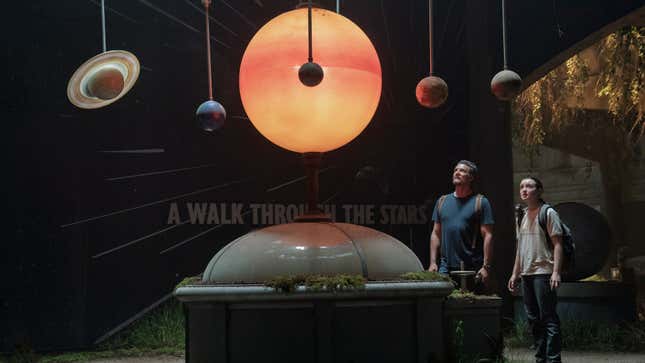
We finally arrive at our destination, and it’s an abandoned museum. Right out front, Ellie finds an overgrown T-Rex statue. Immediately, she climbs up to the top, which just about gives Joel a heart attack. Standing on top of its head, she sees the museum in the distance, and Joel tells her that’s the main attraction, if she doesn’t break her neck falling off the dinosaur. Once inside, we see what Joel wanted Ellie to see: a huge exhibit dedicated to space travel. So far, Ellie has only really fueled her passion for astronomy through textbooks and sci-fi comics, so getting to see a full diorama of the solar system is a dream come true. But her real dream is to go to space. In another life, one in which a fungal infection hadn’t leveled the world, she would’ve been an astronaut going on intergalactic adventures.
Joel can’t take her to space, but he can give her a chance to imagine what it was like. He walks her a bit further into the exhibit and shows her the remains of the Apollo 15 Command Module, which went to space and back in 1971. Ellie is speechless as she excitedly climbs inside, but before she gets in, Joel points out that any astronaut worthy of the title needs a helmet. He hands her a rock to break into one of the suit displays, and she picks her favorite helmet of the bunch.
“How’s it smell in there?” Joel asks.
“Like space…and dust,” Ellie replies.
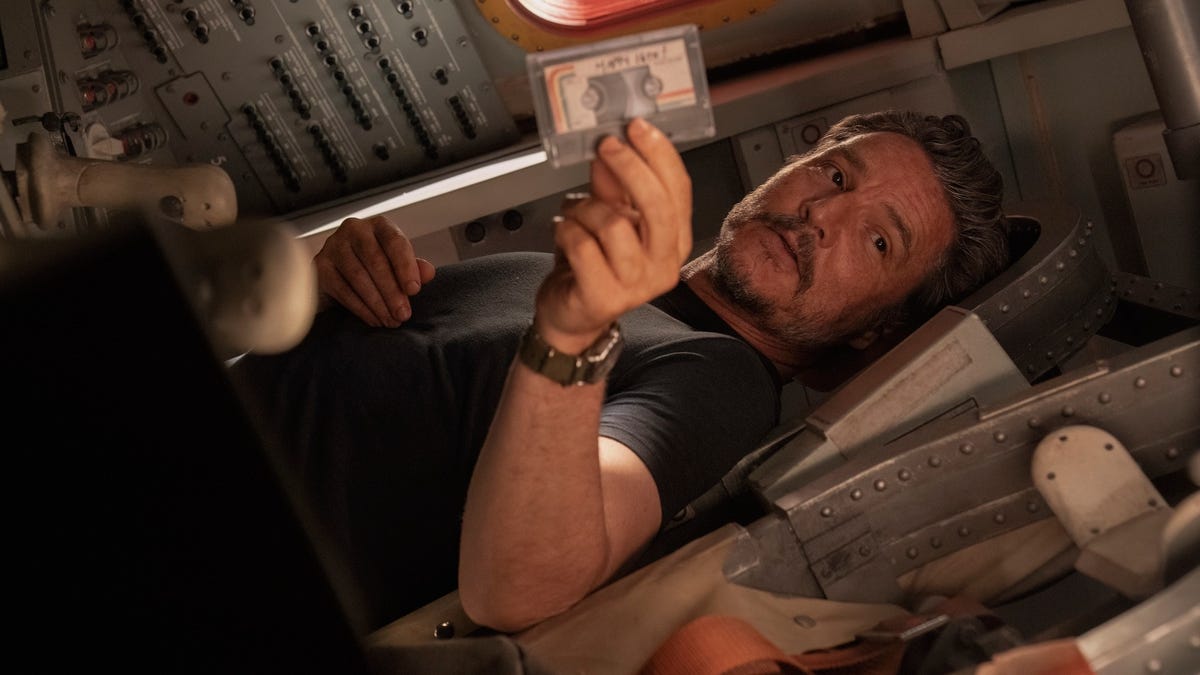
The two get inside, and Ellie starts flipping switches and narrating her space trip. However, Joel has a better idea. He pulls out an old cassette tape, and Ellie asks what’s on it. He says it took a great deal of effort to find in this fucked up world, but doesn’t answer. When Ellie puts the tape in her Walkman, Joel tells her to close her eyes as she listens. When she presses play, she doesn’t get some old world music Joel liked as a teen; instead she hears the countdown of a real orbital launch. She closes her eyes and imagines herself flying up into space. We see the spacecraft shake, the lighting change as it passes through the atmosphere, and then finally, the sun shine over her helmet as she comes back down to Earth. Joel asks if he did okay, and Ellie just lets out a flabbergasted “Are you kidding me?”
Alright, yeah. This scene is still incredible, and I imagine it’ll hit even harder for newcomers who haven’t played the games because they didn’t get a similar scene in season one in which Ellie imagines playing a fighting game. Even before Joel or her first love, Riley (Storm Reid), died, Ellie was a girl in a constant state of grief. She mourns a life she never got to have as she gets nostalgic for a world whose remains she gets to rummage through while scavenging, but that she will never truly experience. Joel can’t give her the world, but he can give her the chance to imagine it, just for a little bit. Joel’s love languages are obviously acts of service and gift giving, and my guy knows how to make a grand gesture even in the apocalypse. God, I know there’s someone out there wagging their fingers about the war crimes but leave me alone, that’s fucking ohana. He’s just a baby girl trying to do nice things for his baby girl.
As the two head back to Jackson, Joel says they should do trips like this more often. Ellie agrees, but then briefly stops as something catches her eye: a group of fireflies gathering in the woods. For a show that loves to just say things to the camera, it’s a nice bit of unspoken storytelling. Ellie stares at them long enough to convey that what happened at Salt Lake City still haunts her, but it’s subtle enough that a viewer who isn’t paying close attention might not catch it.
Dear diary, my teen angst bullshit has a body count
Now it’s time for the 17th birthday. Joel comes home with another cake, but this one spells Ellie’s name right. He heads upstairs to give it to Ellie, but hears giggling inside her bedroom and barges in without so much as a warning. He finds Ellie on her bed with Kat (Noah Lamanna), freshly tattooed, smoking weed and fooling around. Joel goes into full-blown angry dad mode and tells Kat to get out.
“So all the teenage shit all at once,” he barks. “Drugs, tattoos, and sex…experimenting with girls?”
Ellie says it wasn’t sex, and it certainly wasn’t an “experiment.” Joel says she doesn’t know what she’s saying and storms out.
Well, homophobic Joel Miller was not on my bingo card for this show, but it’s done almost nothing but disappoint me, so maybe it should have been. As I wrote when we learned about Dina’s bigoted mother in episode four, the way The Last of Us weaves old-school homophobia into its world has far more long-standing consequences to the series’ worldbuilding than I think Mazin, and now Druckmann and Gross, considered. The more people who are shown to have carried bigotry into the apocalypse, the more it makes it odd that Dina and Ellie have no idea what Pride flags are. The more that queerness is othered in this world, the more its indiscriminate, post-apocalyptic loss of culture instead reads like a targeted one for queer people specifically. I already wrote about that enough for episode four, though, so I want to focus on what it means for Joel to dabble in active bigotry rather than exude the passive ignorance he did in The Last of Us Part II.
There’s an argument to be made that adding this layer of disconnect between Joel and Ellie helps add weight to their reconciliation. If your dad has had homophobic outbursts most of his life, then starts wearing an “I love my lesbian daughter” t-shirt, that’s a feel-good story of redemption worth celebrating. However, was it necessary? Did we need Joel to become a late-in-life homophobe on top of all the other questionable things he’s done? The reason I love him asking if Ellie is interested in Jesse is that it’s a silly, light-hearted interaction. In Part II, the fact that he hasn’t picked up on her being a raging lesbian when he asks about Jesse speaks to how distant the two have become by the time she’s turned 17, and ultimately underlines that he’s a clueless dad at heart. This change for the show, however, replaces ignorance with malice, and the dynamic is entirely different. Yeah, homophobia is inherently ignorant, but Joel asking about Jesse isn’t malicious, it’s just dumb. My man is not reading the room. Here, Joel is reading the room and doesn’t like what he sees.
It’s another example of the show not being willing to leave well enough alone. HBO can’t be content with all the subtle shades of grey the game provided, so it has to expound on everything, no matter how unnecessary or damaging it is for the characters. Joel is no longer just a well-meaning (albeit overbearing and violent) dad to TV viewers, he’s a well-meaning (albeit overbearing and violent) dad who also was secretly a bigot the whole time. Fuck this.
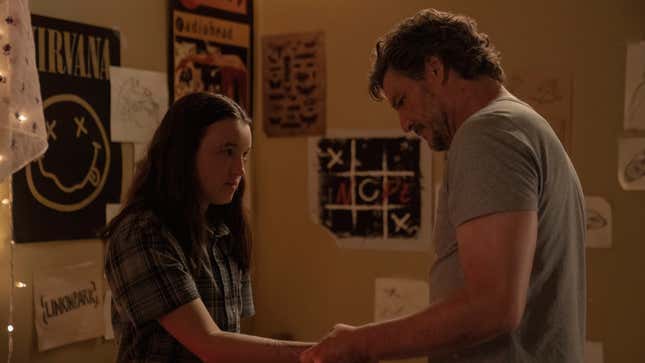
Ellie heads out to the shed in the backyard to get away for a bit. It’s dusty and full of tools, but Ellie’s got a vision and starts to move her mattress out of her room. Joel wakes up and asks what’s going on, and he says Ellie can’t move into the shed overnight because there’s no heat or running water. Ellie says she’s not sorry she smoked weed, got a tattoo, or fooled around with Kat. Rather than admit that homophobia is so 2003, Joel agrees that she should have her own space and says that he’ll spend a few days making it livable. As they put the mattress back on the bed, Joel asks to see the tattoo. It’s not quite finished, but the moth illustration is already inked over the mostly healed burn mark. He asks why she’s so fixated on moths, and she says she read they’re symbolic in dreams. Joel asks if it represents change, and Ellie, clearly not wanting to dig into what it actually means, just says it’s late to get him to leave.
Ah, crap, I forgot about Gail. Hello Catherine O’Hara, I wish you were playing a less frustrating character. Joel ambushes the doctor at the local diner and asks what moths mean in dreams. Gail says moths usually symbolize death “if you believe in that shit.” When Joel seems paralyzed by the answer, Gail, annoyed, asks why he wants to know. He doesn’t answer and heads home.
Ellie has wasted no time getting her shit together to start moving out. The camera lingers over some of her moth sketches, including one that reads “You have a greater purpose” in between the drawings. She grabs them and puts them in a box, but it’s clear the purpose she thought she had weighs on her mind when we see her next.
All the promises at sundown
The show jumps forward two years, almost bringing us to the “present” of the show. A 19-year-old Ellie sits in her hut and rehearses a speech she wants to give Joel. She’s been thinking about his Salt Lake City story and some of the odd inconsistencies with what he told her four years ago. How were the Fireflies surprised by a group of raiders when they saw the pair from a mile away in the city? How did Joel get away from the raiders while carrying her when she was unconscious? Why haven’t they heard from any of the other supposed immune people besides her? Before she can finish her spiel, Joel knocks on her door and says her birthday present this year is that she’s finally getting to go on a patrol. All the animosity melts off of Ellie’s face and is replaced by a childlike glee. She grabs her coat and a gun, and they head out.
The pair head onto what Joel describes as the safest route they’ve got so she can learn the ropes. Ellie’s clearly dissatisfied with wearing training wheels, but the two banter and scout out the area until Joel says it would be nice if they could spend more time together. Ellie hesitantly agrees, clearly once again thinking about Salt Lake City. Joel asks if she’s alright, but the conversation is derailed by a radio call informing them that Gail’s husband Eugene (Joe Pantoliano) spotted some infected and needs backup. Joel tells Ellie to head back to Jackson but she protests, reminding him that she’s not his kid, but his scouting partner. Joel realizes he’s losing time arguing, so they head out.
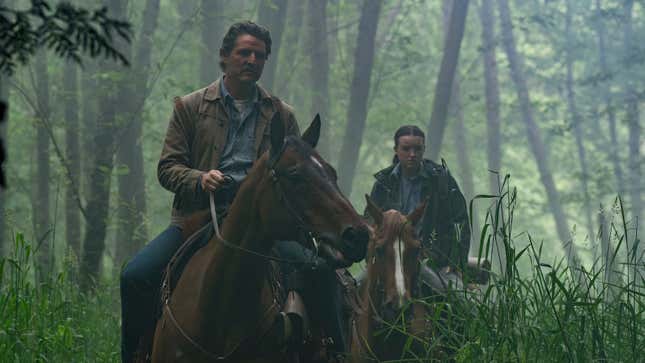
As the two scale down the side of the Jackson mountainside, they hear gunfire and infected screeches in the distance. They follow the noise and see the corpse of Eugene’s patrol partner, Adam, being dragged by his horse, but Gail’s husband is nowhere to be found. Joel leads them down the path the horse came from, and they soon find the aftermath of the scrap, and Eugene leaning up against a tree. Joel asks if he got bit, and while it seems like he considers hiding it for a moment, he shows a bite mark on his side. Joel keeps his gun trained on Eugene, who asks if he can go back to the Jackson gate to say goodbye to his wife before he turns. While Joel isn’t entertaining it, Ellie asks Eugene to hold out his hand and count to 10, and verifies that the infection hasn’t spread to his brain yet. There’s time for him to see Gail. They just need to tie him up and bring him back. Joel hesitates, then tells Ellie to go get the horses, and they’ll meet up. She starts to leave but then stops and turns to Joel with an expectant look. He sends her off with a promise that they’ll be there soon. But he’s promised her plenty of things before.
Joel directs Eugene to a clearing next to a gorgeous lake. But the awe is short-lived as he realizes that Joel never had any intention of taking him back to the town to see Gail. Joel says if he has any last words for his wife, he’ll pass them along. But Eugene didn’t have anything to tell her; he just wanted to hear her last words for him.
“I’m dying!” he shouts. “I’m terrified. I don’t need a view. I need Gail. To see her face, please. Please let that be the last thing I see.”
Joel doesn’t relent and says that if you love someone, you can always see their face. Eugene gives in and stares off into the distance until he dissociates. Then, finally, he tells Joel that he sees her. We never hear the gun go off, but we see a flock of birds fly away from the scene.
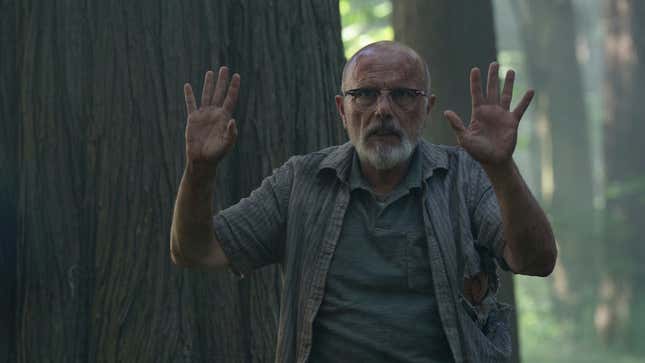
Ellie finally arrives with the horses, and Joel merely apologizes as she stares in horror at what he’s done. He ties Eugene to one of the horses and says he’ll tell Gail just what she needs to know. Ellie is dead silent. She tearfully realizes that Joel’s promises mean nothing as they slowly make their way back to Jackson.
Inside the Jackson wall, Gail cries as she stands over Eugene’s body. Joel tells her that he wanted to see her, but didn’t want to put her in danger as the cordyceps overtook him.
“He wasn’t scared,” Joel says. “He was brave, and he ended it himself.”
Gail hugs Joel both for her own comfort and as thanks for his kind words. But it’s all bullshit. If there’s one thing Joel is good at other than gift giving and torture, it’s lying. But Ellie is here and knows this better than she ever has, and she’s not about to let him get away with it.
“That’s not what happened,” she says. “He begged to see you. He had time. Joel promised to take him to you. He promised us both. And then Joel shot him in the head.”
Joel is stunned, then turns to Gail to try to explain himself, but she slaps him right across the face and tells him to get away from her.
“You swore,” Ellie growls at him before walking away.
For the uninitiated, this entire side story with Eugene is new for the show, and I have mixed feelings on it. It’s well acted, with Pantoliano giving us one of the season’s best performances in just a few minutes of screentime, but it’s also a very roundabout way for the show to finally create what seems like an unmendable rift between Joel and Ellie without them, you know, actually talking about what happened between them. Yes, it’s an extension of that conflict, as Ellie realizes that Joel is a liar who will do what he wants, when he wants, and anyone who feels differently will find themselves on the wrong side of a rifle or with a bogus story to justify it. But we’re not directly reckoning with what happened in Salt Lake City here. As illustrated in the first episode, Joel doesn’t even realize that Ellie’s anger is rooted in what he did to her, and he chalks the distance between them up to teen angst. If I didn’t know any better, I would also be confused as to why Ellie didn’t talk to him for nine months. My guy doesn’t even know that Ellie is on to the fact that he committed the greatest betrayal she’s ever suffered. Which makes the show’s actual unpacking of it all the more oddly paced, and dare I say, nonsensical?
With one more leap forward, we finally reach something familiar from episode one. It’s New Year’s Eve, and Dina (Isabela Merced) is the life of the town’s celebration. Joel is sitting with Tommy and his family and watching Ellie from an acceptable distance. Tommy’s wife, Maria (Rutina Wesley), says that her calling him a “refugee” five episodes ago was out of line, and that he’s still family and has done a lot for Jackson in the years since he and Ellie moved to the town. The sentimental moment is interrupted by Seth calling Ellie and Dina a slur for kissing in the middle of the crowd, and Joel remembers that homophobia is not it and shoves the illiterate, cake-baking, bigoted ex-cop to the ground. He quickly leaves after Ellie shouts at him for interfering, but hey, at least you decided to remember not to be a bigot yourself in your final 24 hours.
Oh my god, I’m bracing myself. I have spent weeks trying to gather the words for talking about this next scene. I work with words for a living, and they usually come naturally to me. But when I first watched this scene recreated in live action, all I could do was fire off expletives as my skin crawled off my body. The tragic part is, this scene is my favorite in all of the Last of Us games. It is the foundation of everything that happens in Part II, and originally, it is only shown to you in the last five minutes, after hours of violent conquest for which the game refuses to provide neat, softening explanations. Troy Baker and Ashley Johnson’s version of this interaction is everything that makes The Last of Us Part II work, condensed into a stunning five-minute scene of career-defining performances, sublime writing that says everything it has to without having to explain it to the viewer like they’re talking down to a child, and a devastating reveal that explains every painful thing you’ve witnessed and done in this game with heartbreaking, bittersweet clarity. I’m talking about Joel and Ellie’s final conversation before his death, and y’all, I cannot believe how badly the show tarnished this scene, and that Druckmann and Gross let it happen.
Part of the issue is that the show’s version of what has become colloquially known as “The Porch Scene” not only has to bear the weight of what was originally Joel and Ellie’s final conversation, but also that it mashes the original scene together with another in such a condensed fashion that it kinda undermines the entire point of Joel and Ellie’s year of no contact. In Part II, there was an entire playable flashback dedicated to Ellie traveling back to the Salt Lake City hospital and discovering the remnants of the Firefly’s base to confirm her worst fears about what Joel had done. It’s much more straightforward than the game’s approach to driving a wedge between the characters, but maybe Mazin and co. thought it was too implausible for show audiences to buy, or they didn’t have the Salt Lake City base set to use anymore. Who’s to say? Instead, we got the Eugene subplot to serve a similar purpose, and Ellie lives with mostly certain but never confirmed suspicions that Joel lied to her about what happened at the hospital. So, on top of the two talking out the Eugene stuff, they also have to lay out the entire foundational conflict between them at once. The result is an extremely rushed revelation and reconciliation, while the show is also juggling Mazin’s overwrought annotated explainer-style writing. So the once-perfect scene is now a structural mess on top of being the show’s usual brand of patronizing.
At first, Ellie walks past the back porch where Joel is playing her guitar, as we saw in episode one. Long-time fans were worried this brief moment might mean the show was going to skip this scene entirely, but it turns out that was just a bit of structural misdirection. The two stand side-by-side at the edge of the porch with their hands on the railing. They occasionally look at each other, but never outright face each other as they talk. Neither of them is quite ready to look the other in the eye just yet.
Ellie asks what’s in the mug Joel’s sipping on, and he says he managed to get some coffee from some people passing through the settlement last week. My king, it is past midnight. We all have our vices, but do you think you need to be wide awake at this hour? Anyway, Ellie’s not here to scold him for his coffee habits; she’s here to set some boundaries. She says she had Seth under control, and tells Joel that she better not hear about him telling Jesse to take her off patrols again. Joel agrees to the terms, and there’s a brief, awkward silence before he asks if Dina and Ellie are girlfriends now. Ellie, clearly embarrassed, rambles about how it was only one kiss and how Dina is a notorious flirt when intoxicated, and asserts that it didn’t mean anything. Joel hears all this self-doubt and asks a new question: “But you do like her?” Ellie once again gets self-deprecating and says she’s “so stupid.” Then Joel goes into sweet dad mode.
“Look, I don’t know what Dina’s intentions are, but, well, she’d be lucky to have you,” Joel says.
Then Ellie says he’s “such an asshole” and gets to what she actually wants to talk about. He lied to her about Eugene and had “the same fucking look” on his face that he had when she asked about the Fireflies all those years ago. But she says she always knew, so she’s giving him one last chance to come clean. “If you lie to me again, we’re done,” she says.
Then Ellie asks every question she wanted to ask on the morning Eugene died. Were there other immune people? Did raiders actually hit the Firefly base? Could they have made a cure? Did he kill the Fireflies and Marlene? For the first time, Joel gives honest answers to all of her questions, and says that making a cure would have killed Ellie, to which she says that she should have died in that hospital then. It was the purpose she felt she was missing in this fucked up world, and he took that from her. He took it from everyone.
All right, so here we go. Most of what’s happened up to this point is, bar for bar, the original script. And then Pascal just…keeps talking, prattling off embellishments and clarifications in keeping with Mazin’s writing style, massacring what was once an excellent example of natural, restrained writing and conflict resolution, all so there’s no danger that the audience watching could possibly misinterpret it. Incredibly complicated characters who once spoke directly to each other without poetic flair are now spoonfeeding all the nuances to viewers like they’re in an after-school special about how to talk to your estranged family members.
I’m going to type up a transcript of this interaction, bolding the dialogue that is new for the show. Take my hand, follow me.
Joel: I’ll pay the price because you’re gonna turn away from me. But if somehow I had a second chance at that moment, I would do it all over again.
Ellie: Because you’re selfish.
Joel: Because I love you in a way you can’t understand. Maybe you never will, but if that should come, if you should ever have one of your own, well then, I hope you do a little better than me.
Ellie: I don’t think I can forgive you for this…But I would like to try.
Welp, glad that’s resolved. Ellie learned about the greatest betrayal of her life and is ready to try moving past it in all of five minutes, rather than taking a full year to sit with that pain before even considering talking to Joel again. Yeah, maybe at this point Ellie is just trying to resolve things with her surrogate father, and that’s less about one thing that transpired than it is everything they’ve been through, but it still feels like the show is rushing through the biggest point of tension these two face in favor of a secondary conflict.
Besties, there are bars on my apartment windows put there by the building owners, and if they hadn’t been there, I cannot guarantee I would not have thrown myself out of my second-story home and suffered an inconvenient leg sprain watching this scene. In just a few additional lines, The Last of Us manages to turn the game’s best scene into one of the most weirdly condescending ones in the show, spelling out every nuance of Joel’s motivations, and explaining his distorted view of what love is with all the subtlety of a Disney Channel Original Movie. It’s not enough for Joel to boldly say he’s seen the fallout of what he’s done and would still have saved Ellie’s life, the show has to make sure you understand that he did it not because he’s a selfish bastard trying to replace one daughter with another like all the meanies who hate him say online, but because he loves her…while also quoting his newly-revealed abusive father. God, I can already hear Ellie likely quoting this “doing better” line when she makes a big decision at the end of Part II’s story in a hokey attempt to bring all of this full circle. I already hate it, HBO. It’s not too late to not have her quote an abusive cop when talking about her as-of-yet unborn child.
Watching this scene feels like having an English teacher’s hand violently gripping my shoulder, hammering down every detail, and making sure I grasp how important the scene is. It’s somehow both lacking confidence in the moment to speak for itself while also feeling somewhat self-important, echoing how The Last of Us as a whole has been publicly presented in the past five years. Sony and HBO’s messaging around the franchise has been exhaustingly self-aggrandizing in recent years, as they’ve constantly marketed it as a cultural moment too important to be missed. That’s why it’s been remastered and repackaged more times than I care to count, and why we’ve reached peak Last of Us fatigue.
The Last of Us has reached a point of self-important oversaturation that even I, a diehard fan, can’t justify. But while Sony’s marketing has often felt overbearingly self-important, that quality never felt reflected in the actual text. Here, however, the Last of Us show insists upon driving home the lessons it wants to teach so blatantly and clumsily that I once again find myself feeling that this adaptation was shaped by discourse, reacting to potential bad-faith (or just plain bad) responses in advance rather than blazing trails on its own. It knows this moment is important to fans who spent a whole game fearing Joel and Ellie parted on bad terms before his death, so it’s gotta make sure viewers, who only had to wait halfway through the story, know how significant it is, too, by laying the schmaltzy theatrics on real thick when understated sentimentality would’ve sufficed. Even the best moment in the game isn’t immune to the show’s worst tendencies.
I’ve spent the whole season racking my brain about why Mazin chose to rewrite The Last of Us Part II’s dialogue this way, because the only explanations I can come up with are that he believes this to be an improvement on the source material or that he thinks the audience couldn’t follow the nuances of this story if they weren’t written out for them like in a middle school book report. But after seeing how the show butchers Joel and Ellie’s final talk, I don’t think his motivations matter anymore. The end result is the same. Even though HBO is stretching Part II’s story out for at least one or two more seasons, I don’t think there’s any coming back from this haughty dumbing down of the game’s dialogue. The Last of Us has already fumbled the landing before the story’s even halfway over. The show will continue, but as far as I’m concerned, it’s a failed experiment, and it’s fucking over.
Now, we’re back in the present day. As Ellie walks through a rainy Seattle back to the theater where Dina and Jesse are waiting, and we’re back in the midst of her revenge tour, I have whiplash. HBO has already shown its hand. We’re at least another season away from seeing the resolution to this entire conflict, but we already know…almost everything? We know Abby killed Joel as revenge for him killing her father. We know Ellie is so hellbent on revenge (well, that’s debatable, considering the show has drained her of that drive and given it to Dina instead) because she was denied the opportunity to truly reconcile with Joel. The show has demolished so much of its narrative runway that I don’t know what the tension is supposed to be anymore. Wondering who lives and dies? Well, fucking fine. I’ll watch the show aimlessly and artlessly recount the events of the game, knowing its ending, which feels more predictable than ever, is coming in a few years.
