


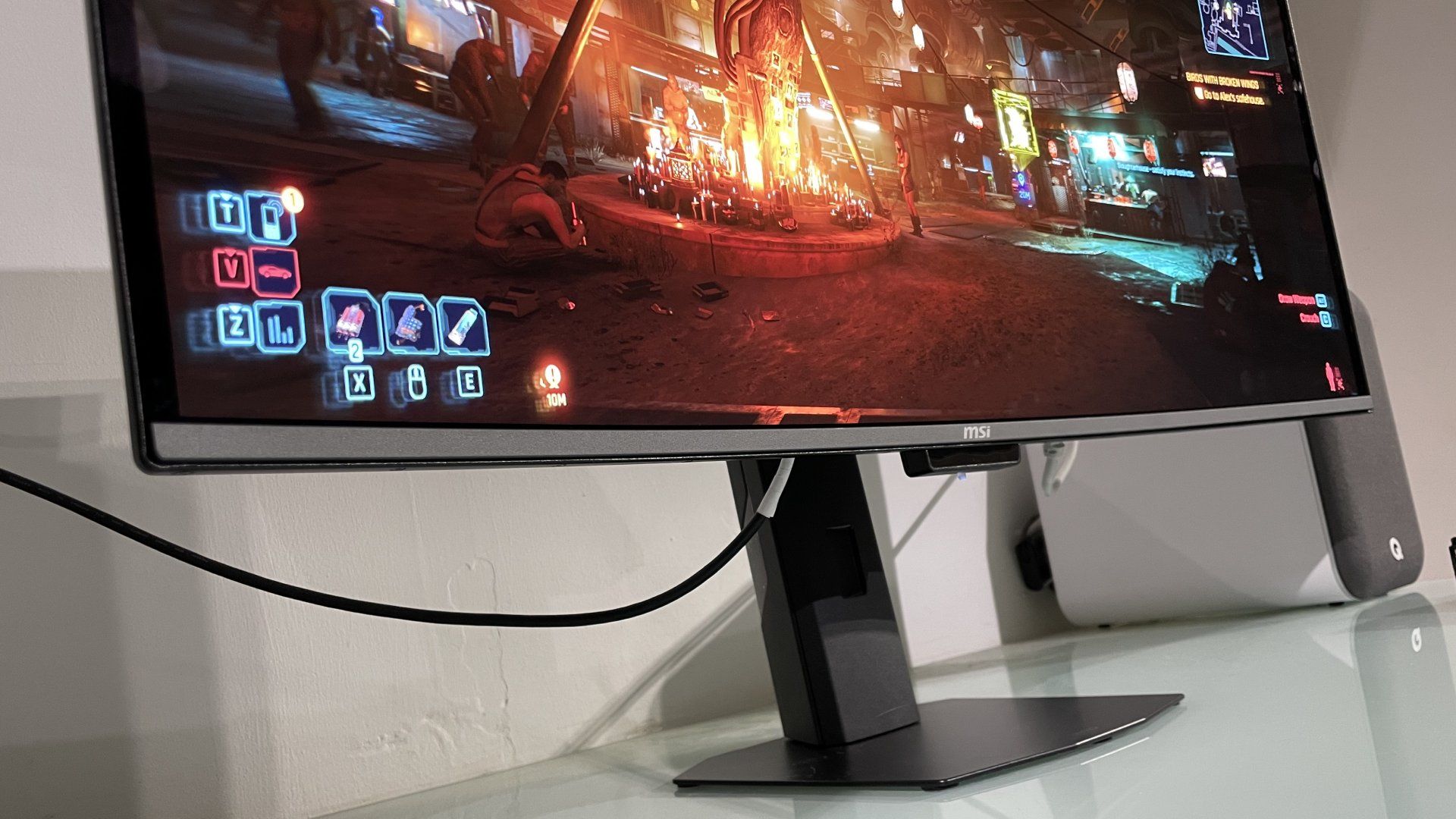
The new MSI MPG 341CQR QD-OLED X36 has an utterly appalling name for an incredibly appealing monitor. Our Jeremy spent the Christmas week testing the new gaming screen featuring the very latest 5th Gen Samsung QD-OLED panel, and has come out the other side giving it an ed’s pick award and a high score of 92%.
Review
“This MSI is a fantastic demonstration of Samsung’s latest QD-OLED tech. The HDR experience is stupendous, the ambient light absorption issue is mostly entirely solved and the subpixel structure has been sorted. It’s just needs a few more pixels to be absolutely perfect for both gaming and daily computing.” -Jeremy Laird
Read our full MSI MPG 341CQR QD-OLED X36 review.
And he’s not an easy person to please when it comes to gaming monitors, especially those with actually relatively low resolutions and pixel density figures. After all, the new MSI display is a 34-inch ultrawide with a 3440 × 1440 native resolution and therefore a 110 ppi density metric.
With every other QD-OLED I’ve tested and touched with my eyeballs, that combination would have us all retching uncontrollably. Font fringing. That’s the problem, and it makes all those old 34-inch panels—and basically anything with a native res under 4K and/or screen size bigger than 32-inches—seriously unpleasant to use for anything outside of pure gaming.
When you’ve got a game loaded up fullscreen, and you’re fragging away with gay abandon, then you’ll notice not a thing and be wondering why I’m making sick cat noises around your 1440p OLED monitor. But as soon as you exit and try to read pretty much any bit of text rendered in Windows you’ll see what I mean and the dry heaving will begin.
Without getting too technical, the issue is down to the subpixel layout of previous QD-OLED panels which used a weird triangular structure. The design is absolutely fine for a TV you’re going to be sat on a sofa watching, less so for a smaller panel that’s going to be positioned a couple of feet (at most) from your nose.
The result was an indistinct edge to fonts and coloured fringing around the outside. With the new RGB stripe layout—essentially just the red, green, and blue subpixels arranged left to right—that issue is all but entirely removed. Take this to a 27-inch 4K panel and it will be completely gone, I’d wager.
Right now, it’s only available in this 34-inch 3440 × 1440 Samsung panel, but further panel configurations will become available throughout the coming year.
But it’s not just fixed the font fringing problem, the MSI monitor also features a semi-glossy coating and panel layer that enhances light absorption. Put a Samsung QD-OLED and LG WOLED side-by-side, shine a light on both, and you’ll see a slightly purple tinge come to the surface. With this new PureBlack layer that’s far less noticeable. There is still a difference between the two OLED panel technologies, but you’ve got to be firing a really strong light at the panels to really see it.
What about peak brightness? Well, that’s not exactly a game-changer, with the new panel offering a fullscreen average brightness of 300 cd/m2. That’s better than the previous 250 and 275 cd/m2 ratings of older QD-OLED generations, but we really want to be getting up to 400 cd/m2 for OLED brightness to be effectively a solved thing.
Still, with some effective MSI tuning, the MPG 341CQR QD-OLED X36 delivers the best HDR experience, both in dark scenes with pin sharp highlights and in bright outdoor scenes, too. That’s a first for PC OLED gaming monitors.
The new panel will be out very soon, with a ~$1,100 price tag. But MSI has long been ultra competitive when it comes to panel pricing, so I would expect to see that drop sometime throughout the year. If only the hardware to drive it would do the same.
Best gaming monitors 2025
